
Authored by John Seed, Art Historian
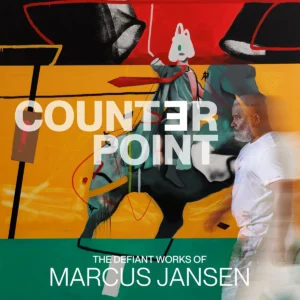 In his new book Counterpoint the artist Marcus Jansen presents more than 50 of his paintings alongside personal commentaries exploring their sources, contexts and meanings. The book is a milestone for Jansen in the sense that it feels like a museum retrospective between two covers, offering a dense cross section of his challenging imagery.
Jansen’s art emanates from the hybrid and often contradictory cultural experiences that have shaped his life. Born into a Caribbean family, he grew up in both the U.S. and Europe, and served in the U.S. Military. As a mature artist, Jansen has an uncanny ability to shape his intellectual, cultural and historical perceptions into imaginative vignettes that challenge accepted narratives. His frank and stinging criticisms of Colonialism and the embedded racism it engendered permeate his paintings and give them striking thematic impact. So does Jansen’s hybrid approach to style which brings together elements of Expressionism, DaDa and Graffiti Art.
Jansen’s targets — including urban decay, racist monuments, corporate power, technology and imperialism — are portrayed in vivid, often fragmented contexts. The moods he evokes — which are often satirical — are enhanced by formal distortions, collage-like appropriations, bold use of color and bits of inserted language. His work and ideas do not unfold in a linear fashion or hold to a specific timeline: each painting emerges as a focused statement that can stand on its own or be interwoven into the greater body of the artist’s oeuvre. Counterpoint also includes historic photos and paintings that offer examples of the history he challenges and inverts.
In his introduction Jansen mentions “the erasure of voices” that has taken place in American culture. He is referring to the voices of indigenous, non-white and African people whose experiences his art insistently returns to public consciousness. Jansen’s stirring art has a powerful moral quest at its heart, and this book is a chronicle of his ability — through art — to tell stories that should outrage and inspire all Americans to see what he sees and to challenge accepted historical narratives. In that sense, his art is a quest for both higher moral ground and cultural unity.
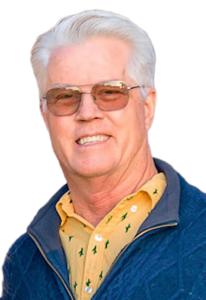 John Seed is a professor emeritus of art and art history at Mt. San Jacinto College in Southern California. He holds a BA with distinction in Studio Art from Stanford University and an MA in Studio Art from UC Berkeley. Early in his career he served as a studio assistant to Jean-Michel Basquiat. Seed has written for numerous publications including Arts of Asia, Hyperallergic.com, and Sotheby’s Magazine. He is the author of Disrupted Realism: Paintings for a Distracted World (2019) and More Disruption: Representational Art in Flux (2023).
